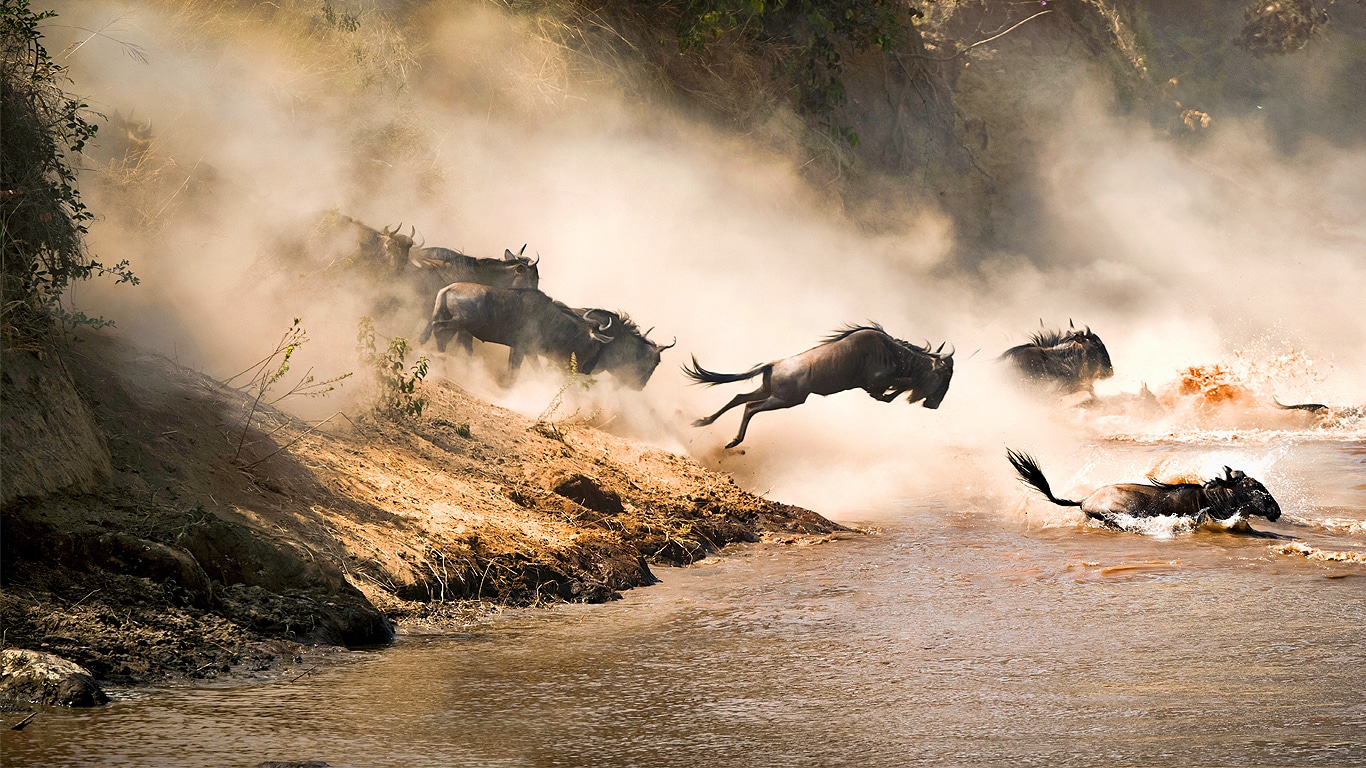
Where the land runs on forever.
The Serengeti covers 14,750 km² of open plains, granite kopjes and river forest. Every year more than 1.5 million wildebeest walk its length, and it has been a UNESCO World Heritage Site since 1981. This is how to see it properly.
In the park this month
Northern Serengeti
September: Crossings continue
The herds follow the rain, so dates shift by a few weeks each year.
Serengeti comes from the Maasai word Siringet, the place where the land runs on forever.
Nothing here is small. Grass plains run to the horizon, herds move in columns that take hours to pass, and the sky takes up two-thirds of every view. It is one of the last places on Earth where a whole ecosystem still moves the way it has for millennia.
Almost nothing stays still for long, and that is the point. A good Serengeti safari is not about racing between sightings. It is about staying long enough with a lion pride, a river bank or a herd to see what happens next.

Grass plains
Volcanic ash from Ol Doinyo Lengai has enriched the soil for thousands of years. The short grass in the south is packed with minerals, which is why the herds return there to calve.
Granite kopjes
Ancient granite outcrops rise from the plains like islands. Lion prides sleep on them, leopards hide among them, and they collect rainwater, making them vital refuges for wildlife.
Rivers and forest
The Seronera, Grumeti and Mara rivers hold water in the dry months, and the woodland that follows them shelters leopards, hippos, crocodiles, colobus monkeys and hundreds of bird species.
Follow the herds through a whole year.
Choose a month, or play the year, and watch the herd move around the ecosystem. The migration is a continuous loop of roughly 800 km driven by rainfall, so there is no wrong month, only a different chapter.
September
Northern Serengeti
Crossings continue
Crossings continue, often with fewer vehicles than August. The northern grass is golden and dry, and lion prides hold the river-side thickets.
Rain sets the schedule, not the calendar. We follow the herds closely through the season and place you where the action really is, not just where the calendar says it should be.
One ecosystem, four regions, and the herds pass through all of them.
Open each region to see what defines it, what you will see and how we plan it. The bars show the best months to visit, and the outlined bar marks this month.
Southern Plains
Ndutu and the southern Serengeti
JanDec
Southern Plains
Ndutu and the southern Serengeti
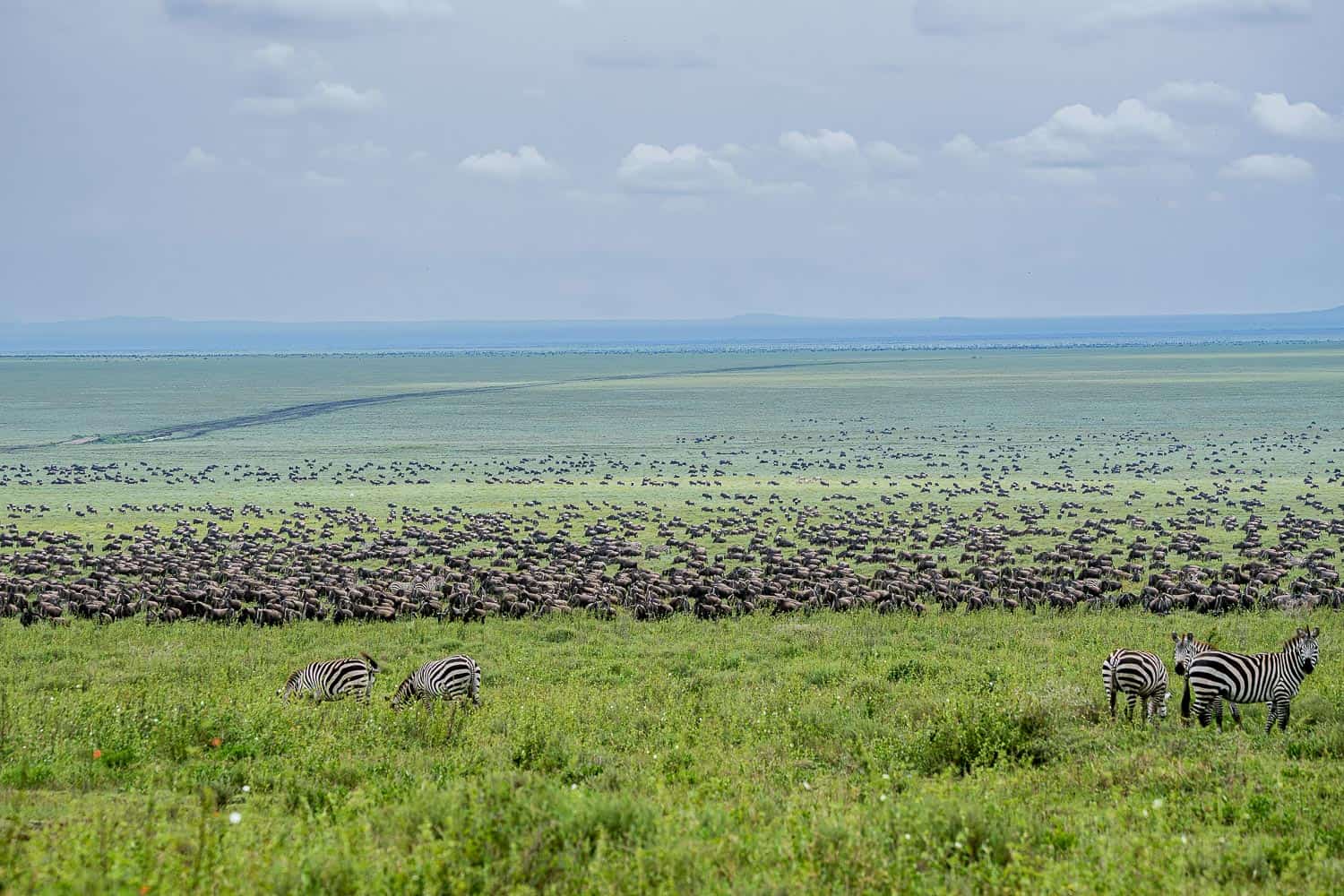
Short grass, mineral-rich soil, and the greatest birth event on Earth.
Volcanic ash from Ol Doinyo Lengai has fed these plains for millennia, and the short, mineral-rich grass is the reason hundreds of thousands of wildebeest calves are born here in just a few weeks between late January and March. The horizon is enormous and the hunting is out in the open, so this is where you watch predators and prey at full stretch.
What you will see
- Calving herds with newborns standing within minutes
- Cheetah scanning from termite mounds and stalking the open grass
- Lion and spotted hyena working the edges of the herds
How we plan it
Ndutu straddles the border of the Ngorongoro Conservation Area, and the herds shift week to week. We base you close to where calving is actually happening rather than where it happened last year.
Western Corridor
The Grumeti River area
JanDec
Western Corridor
The Grumeti River area
Greener, more wooded country where the herds meet their first river.
A band of river forest and open woodland runs west toward Lake Victoria. As the herds funnel along the Grumeti, Nile crocodiles, some of them huge, wait at the crossing points. It is a quieter preview of the Mara, with fewer vehicles and a richer mix of habitat, including black-and-white colobus monkeys in the forest canopy and excellent birding.
What you will see
- Grumeti River crossings when the herds arrive
- Large crocodiles basking on the banks
- Colobus monkeys, hippo pools and forest birds
How we plan it
Crossings here are less predictable than at the Mara. We keep itineraries flexible and check in with guides in the field each day so you are in the right place at the right hour.
Northern Serengeti
Kogatende and the Mara River
JanDec
Northern Serengeti
Kogatende and the Mara River
The river crossings the whole world pictures.
Far from the busy centre of the park, the north is remote, rolling and wild. Herds mass on the banks of the Mara River, wait, retreat, then pour down the banks into water where crocodiles and lions are waiting. Crossings cannot be scheduled, so the reward is patience: long mornings on the bank, and then, suddenly, everything at once.
What you will see
- Mara River crossings, from first hesitation to the final scramble up the far bank
- Lion prides and leopards along the river thickets
- Big skies with very few other vehicles
How we plan it
August is the most requested month, so we reserve early. We place you at camps within reach of the crossing points and plan long days at the river, with picnic lunches, so you are never rushed away from the action.
Central Serengeti
The Seronera Valley
JanDec
Central Serengeti
The Seronera Valley
The reliable heart of the park, whatever the herds are doing.
The rivers of the Seronera valley hold water when the plains dry out, so wildlife concentrates here in every season. Lion prides live on the granite kopjes, leopards rest in the branches of sausage trees along the river lines, and cheetahs work the grass between. It is the foundation of nearly every Serengeti safari, and the launch point for dawn balloon flights.
What you will see
- Leopards draped over the branches of riverside trees
- Resident lion prides on and around the kopjes
- Hippo pools, elephants at water and big buffalo herds
How we plan it
Seronera is popular, so we time our drives around the busiest hours and use quieter loops. It pairs well with any migration region for a fuller picture of the ecosystem.
A day on the plains, hour by hour.
Safari has a rhythm. Animals are active when the air is cool, so your day is built around the two golden windows at either end, with a long rest in between. Here is what a typical day looks like.
-
05:45
First light
You leave camp in cold, quiet air as the sky turns from indigo to gold. Cats often finish the night’s hunting at this hour, and the low light is the best you will get for photographs.
-
07:30
Breakfast in the bush
Coffee, eggs and fruit served from the back of the vehicle at a scenic spot, ideally with a view over the plains or a river bend, and your guide’s stories from the morning so far.
-
09:00
The morning drive
Herds are on the move, lions are moving toward shade, and the birdlife is loud. This is the slow, patient part of the day, following tracks and reading behaviour rather than racing between sightings.
-
12:30
Midday rest
Lunch back at camp, then a long break. The heat sends most animals into shade, so you do too. A pool, a hammock, or a quiet hour with binoculars from the tent porch.
-
15:30
The afternoon drive
The plains wake up again. Elephants head for water, lions stir from their rest, and hunting picks up as temperatures fall.
-
18:15
Golden hour
Acacia silhouettes and long shadows on the grass. Sundowners come out, and the vehicle heads back toward camp as the light fades.
-
20:00
Night on the plains
Night driving is not permitted inside the national park, so evenings belong to the campfire, dinner under the stars, and the sounds carried across the dark: hyena whoops, lion roars, and the rustle of something walking past your tent.
Beyond the migration, a resident cast that never leaves.
A field checklist of the animals most visitors hope to see, where to look for them and when. Wildlife is never guaranteed, but this is where our guides start.
-
Lion
Where: Seronera kopjes; southern plains during calving
When: All year
Roughly 3,000 live in the park, one of the largest lion populations in Africa.
-
Leopard
Where: Seronera River and its sausage trees
When: Dawn and dusk
Solitary and elusive. Look up into the branches, and be patient.
-
Cheetah
Where: Southern plains and open grassland
When: December to March
Needs open ground to sprint. Often spotted on termite mounds scanning for prey.
-
African elephant
Where: Central, western and northern regions
When: Dry months
Herds concentrate near rivers and waterholes when the grass dries out.
-
Cape buffalo
Where: Woodland and river areas in the centre and west
When: All year
Herds of hundreds gather near water. Powerful and unpredictable.
-
Black rhino
Where: Moru Kopjes area
When: All year
Rare and closely protected. A sighting is a privilege, never a promise.
-
Spotted hyena
Where: Plains and clan dens across the park
When: All year
One of the region’s most successful hunters, and far more than a scavenger.
-
Hippopotamus
Where: Retina Hippo Pool, Seronera and the Mara River
When: Dry months
Packed into shrinking pools as water becomes scarce. Loud at dusk.
-
Maasai giraffe
Where: Acacia woodland throughout the park
When: All year
Tall, calm and endlessly photogenic against a low sun.
-
Birdlife
Where: Everywhere, from plains to river forest
When: Migrants November to April
More than 500 species, including kori bustard, secretary bird and lilac-breasted roller.
Designed around time, space and meaningful encounters, not rushed sightseeing.
Private game drives
A private 4x4 with a pop-up roof, an expert driver-guide and a window seat for everyone. You decide how long to stay at a sighting, and we follow your pace rather than a group schedule.
Dawn balloon flights
Drift over the Seronera valley at sunrise for about an hour, then land for a bush breakfast. Flights must be booked in advance and depend on the weather, but it is unforgettable when it works.
Mobile camps that follow the herds
Seasonal tented camps are moved through the year to sit close to the migration. They are light on the land and put you within minutes of the action, with real comfort and a true bush atmosphere.
Permanent lodges and camps
Fixed locations chosen for their views and their reliable game. They offer pools, spas and more space, and they are a good base in the Central Serengeti where wildlife stays put year-round.
Three ways to spend your days here.
Illustrative routes built around the migration calendar. Every safari is tailored to your dates, pace and budget.
Best for
Predator action, newborn calves and wide open horizons.
Based around
Ndutu and Seronera
- Day 1 Arrive in Arusha, meet your guide and settle in. A relaxed briefing over dinner.
- Day 2 Drive to the Ngorongoro Crater rim, with a full morning game drive on the crater floor the next day.
- Day 3 Head to Ndutu and spend the afternoon among the calving herds.
- Day 4 A full day on the southern plains, following the herds and the cheetahs that follow them.
- Day 5 A final morning drive, then continue to Seronera for a flight back to Arusha.
Best for
River crossings with fewer vehicles, plus forest and birding.
Based around
Seronera and the Western Corridor
- Day 1 Fly from Arusha to Seronera and take an afternoon game drive in the valley.
- Day 2 A full day around Seronera for leopards and lions, with an optional dawn balloon flight.
- Day 3 Drive west into the Western Corridor and follow the herds toward the Grumeti River.
- Day 4 A full day along the river and forest: crossings, crocodiles, colobus monkeys and birds.
- Day 5 A final morning drive, then a flight from a western airstrip back to Arusha.
Best for
The dramatic river crossings and remote northern wilderness.
Based around
Kogatende and the north
- Day 1 Arrive in Arusha and prepare for the journey north.
- Day 2 Fly to Kogatende airstrip in the far north and go straight out to the river.
- Day 3 A full day at the Mara River with a picnic lunch, waiting for and following the crossings.
- Day 4 A second full day at the river, or exploring the Lamai area for big cats.
- Day 5 Another morning at the river, then game drive to a new location for the late afternoon.
- Day 6 A last sunrise drive, then fly back to Arusha.
Good to know before you go.
The questions we hear most often. If yours is not here, ask us.
When is the best time to visit the Serengeti?
It depends on what you most want to see. January to March is calving season on the southern plains. June is the Grumeti crossings. July to October is Mara River crossing season. The dry months from June to October usually give the clearest wildlife viewing, while the long rains from March to May are greener, quieter and better value. The Central Serengeti is good all year.
How many days do I need?
We recommend at least four nights inside the park. If you want to see two regions, such as the Seronera valley and the Mara, plan for five to seven nights so you are not spending most of your time on the road. The migration follows the rain, so extra days give you more chances to be in the right place.
Should we drive or fly in?
Driving from Arusha is a long day, typically eight hours or more including stops, though it can be combined with the Ngorongoro Crater. Light aircraft flights from Arusha to airstrips such as Seronera or Kogatende take roughly one and a half to two hours and give you more time on safari. We advise on the best mix for your dates and region.
Will it be crowded?
The Seronera valley and the Mara crossing points in August can attract many vehicles. We reduce this by choosing quieter areas and times, using less busy tracks, and building itineraries around when other groups are at lunch or breakfast. The north, west and south are much less crowded than the centre.
What should I pack?
Neutral clothing in khaki, olive and tan, warm layers for early mornings, a wide-brimmed hat, sunscreen, sunglasses, binoculars and a camera with a good zoom. If you travel by light aircraft, pack in soft bags; luggage limits are usually around 15 kg per person.
Do I need vaccinations or malaria tablets?
Speak to a travel health clinic or your doctor well before you travel, since recommendations depend on your health and home country. We also strongly recommend travel insurance that covers medical evacuation. Our guides are trained in first aid and stay in regular contact with base.

Tell us your dates. We will tell you where the herds will be.
Share how you want to experience Tanzania, and we will shape a considered safari around your pace and interests, with real guidance on which region and month suit you best.
Plan your safari