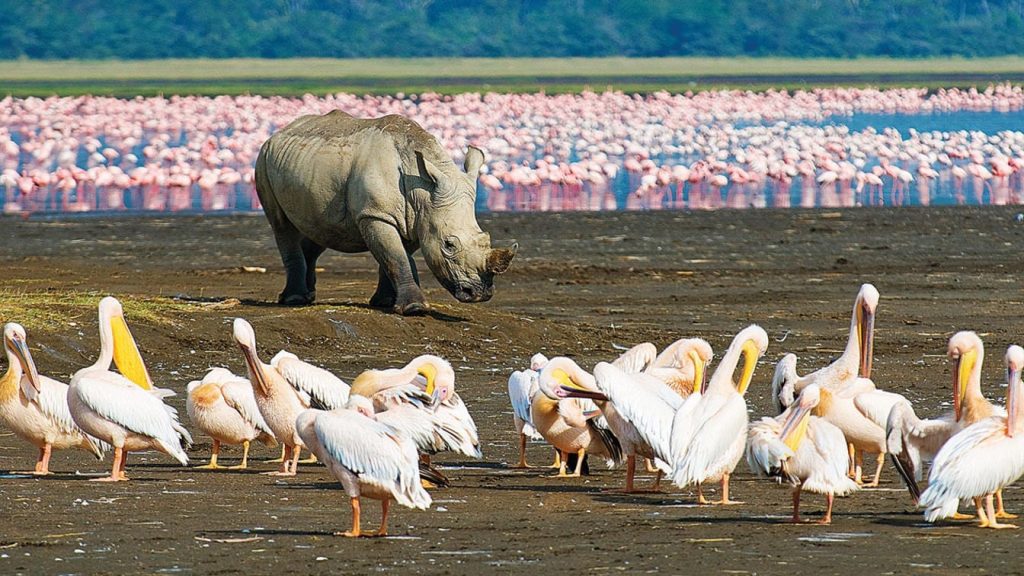
Lake Manyara landscape beneath the Rift Valley escarpment

Northern Tanzania

A narrow strip, a whole world.

Squeezed between the wall of the Great Rift Valley and an alkaline lake, Manyara packs forest, woodland, grassland and shoreline into a park you can cross in a morning — and still not run out of things to see.

Manyara at a glance

330 km², two-thirds lake

Tree-climbing lions, dense elephant herds, flamingos

One of Tanzania's smallest parks by area, and among its densest for wildlife per square kilometre.

A wilderness measured in metres, not kilometres.

Where Ruaha rewards distance, Manyara rewards compression — everything sits close together, and the drive from one habitat to the next can take minutes rather than hours.

The 600-metre wall of the Rift Valley feeds a spring-line forest that would have no business existing in this climate. Behind it, woodland, floodplain and grassland lead to a shallow alkaline lake that covers two-thirds of the park. Few places pack this much habitat into so little ground.

Park size
330 km², of which roughly two-thirds is the lake itself.
Location
Northern Tanzania, on the road between Arusha and Ngorongoro/Serengeti, near Mto wa Mbu.
Landscape
A narrow strip barely a few kilometres wide, compressed between a 600-metre Rift Valley escarpment and Lake Manyara.
Defining feature
Spring-fed groundwater forest at the base of the wall, and the alkaline lake at the opposite edge.
Wildlife
Tree-climbing lions, exceptionally dense elephant herds, large primate troops and buffalo.
Birdlife
More than 400 species recorded, including seasonal flocks of lesser and greater flamingo.
Park history
Gazetted as a national park in 1960; part of Tanzania’s northern safari circuit.
Forest and woodland habitat typical of Lake Manyara

The character of Manyara

Small park, outsized biomass.

  1. 1

    A world stacked in a few kilometres

    Forest, woodland, grassland and lake shore sit within a strip only a few kilometres wide.

  2. 2

    Water two ways

    Rift-fed springs sustain the forest at one end; an alkaline lake covers two-thirds of the park at the other.

  3. 3

    Unusually high density

    Relative to its size, Manyara holds some of the highest elephant and primate densities in Tanzania.

  4. 4

    On the road to everywhere else

    Tarangire, Ngorongoro and the Serengeti are all reachable the same day, making Manyara a natural first or last stop.

Cut a line from the wall to the water.

Manyara isn't crossed hour by hour so much as layer by layer. Follow the strip from the Rift escarpment down through forest, woodland and grassland to the lake shore.

Wall of the Rift Valley → groundwater forest → woodland → grassland → alkaline lake 1 The Rift wall 2 The groundwater forest 3 Acacia woodland 4 Open grassland 5 The alkaline lake

The escarpment that shapes everything

The Rift wall

A 600-metre wall of the Great Rift Valley rises immediately to the west of the park. Rain running off it feeds underground springs that surface at the base of the escarpment, which is the reason a forest can exist here at all despite the low rainfall of the surrounding plains.

What to look for

  • Sweeping views across the Rift Valley floor
  • Rock hyrax and klipspringer near the escarpment base
  • The full cross-section of the park laid out below

A guide’s tip

Ask your guide to stop at the escarpment viewpoint on the road above the park. Seeing the whole strip from wall to lake in one glance makes sense of everything you visit below.

Four groups, one very small park.

Manyara's reputation rests on a handful of specialities rather than sheer species count — and each one is tied to a particular layer of the park.

The tree climbers

Manyara is one of only a handful of places in Africa where lions regularly climb trees, thought to be an escape from heat, biting flies and long grass.

  • Lion

    Manyara’s signature sighting — look up into acacia and sausage tree branches, not just the grass.

  • Leopard

    Present but elusive, most often found in denser forest and woodland edges.

  • Spotted hyena

    Frequently heard after dark around camps bordering the park.

Elephant country

Relative to its size, Manyara holds one of the highest elephant densities in Tanzania, often encountered at close range in forest and woodland.

  • Elephant

    Family herds move through the forest and woodland year-round.

  • Buffalo

    Large herds graze the woodland edges and open grassland.

  • Giraffe

    Commonly seen browsing acacia canopy.

  • Hippo

    Resident in pools near the lake shore, including the well-known Hippo Pool.

Forest & primates

The spring-fed groundwater forest supports some of the largest primate troops found anywhere in East Africa.

  • Olive baboon

    Troops here are among the largest recorded in Africa.

  • Blue monkey

    Common in the shaded canopy near the park entrance.

  • Bushbuck

    Found in thicker forest and woodland cover.

Lake & birdlife

More than 400 species have been recorded, with the alkaline lake drawing spectacular numbers of waterbirds.

  • Lesser & greater flamingo

    Numbers shift with lake conditions and can turn the shoreline pink.

  • Pelican, stork & heron

    Common around the shallows and shoreline.

  • Fish eagle

    Often perched along the lake edge.

The lake sets the calendar here.

More than most parks, Manyara's seasons are really about water — how much is falling on the escarpment, and how full the lake itself is.

The dry season

June to October

Reliable year-round water keeps wildlife in good condition and easier to find around the forest, woodland and shoreline.

Best for

Classic game viewing, night drives and general wildlife activity.

Keep in mind

The park can feel busier, being on the main road through the northern circuit.

The short rains

November to December

Rain begins to lift the lake’s water level, and birdlife starts to build across the shoreline and floodplain.

Best for

Early canoeing conditions and building bird numbers.

Keep in mind

Some tracks can be affected by rain.

Flamingo & green season

January to March

The lake is often at its most colourful, with flamingo flocks and lush, green surroundings.

Best for

Flamingo photography, birding and canoeing when water levels allow.

Keep in mind

Wildlife can be more dispersed as water is widespread.

The long rains

April to May

The forest is at its most lush and the park is at its quietest, with dramatic storm skies over the escarpment.

Best for

Solitude, greenery and photography of the wall itself.

Keep in mind

Some activities and roads run with seasonal limitations.

Alkaline lake shoreline typical of Lake Manyara

Manyara's size means more than driving.

Being compact and close to Mto wa Mbu lets Manyara offer activities that a vast, remote park like Ruaha simply can't.

Night game drives

Manyara is one of the few Tanzanian parks where guided night drives are permitted, run in specially equipped vehicles after dinner.

Leopard, hyena, genet, civet and porcupine are all more active after dark, and hippos are often found grazing beside the road.

Canoeing

When water levels are high enough — typically during the short and long rains — canoeing on the lake edge can be arranged, subject to park permit and conditions.

A quiet, low-level view of hippo, waterbirds and elephant drinking at the shoreline.

The canopy walkway

A treetop walkway through the groundwater forest, among the longest of its kind in Africa, puts you above the forest floor rather than driving through it.

A different perspective on the forest canopy, blue monkeys and forest birdlife.

Mto wa Mbu village & biking

Just outside the park gate, the village of Mto wa Mbu is known for its mix of communities from across Tanzania. Guided walks or mountain-bike rides pass farms, a local market and craft workshops.

A cultural counterpoint to the game drives, easily added on arrival or departure.

Manyara sits on the road to everywhere.

Unlike a remote southern park, Manyara is a stepping stone on Tanzania's busiest safari route north.

  • Tarangire National Park

    Linked to Manyara by the Kwa Kuchinja wildlife corridor, Tarangire adds giant baobabs and some of Tanzania’s largest elephant herds to the same trip.

    The next stop north or south

  • Ngorongoro Crater

    The crater highlands sit just beyond Manyara on the road toward the Serengeti, making it a natural next stop.

    A short drive up the escarpment

  • Serengeti National Park

    Manyara is often the first or last stop on a northern circuit itinerary that runs on to the Serengeti’s plains.

    The classic circuit continues

  • Maji Moto hot springs

    Natural hot springs near the park boundary make an easy half-day addition on the way in or out.

    Just outside the park

Continuing the circuit? Explore Tarangire National Park.

Three ways to build Manyara into your journey.

These are starting points. Every Dunia Moja safari can be tailored around your dates, pace, accommodation and budget.

A northern-circuit stop

1 night, best Year-round

  1. 1 Arrive from Arusha or Tarangire and settle in for the afternoon
  2. 2 Afternoon game drive through forest and woodland to the lake shore
  3. 3 Morning drive before continuing toward Ngorongoro or the Serengeti

Manyara in depth

2 nights, best June to October for classic game viewing

  1. 1 Forest walk or canopy walkway on arrival
  2. 2 Full game drive from forest to lake shore
  3. 3 Optional night game drive or canoeing where conditions allow
  4. 4 Morning drive before departure

Full northern circuit

8 to 10 days, best June to October, or January to March for flamingos

  1. 1 Arusha to Tarangire National Park
  2. 2 Tarangire to Lake Manyara
  3. 3 Manyara to Ngorongoro Crater
  4. 4 Ngorongoro to the Serengeti
  5. 5 Return by road or scheduled flight to Arusha

Good to know before you go.

The questions that matter when planning a Manyara safari. If yours is not here, ask us.

Why is Manyara famous for tree-climbing lions?

Lions here are known to rest in the branches of acacia and sausage trees, a behaviour seen in only a few places in Africa. It is thought to help them escape heat, biting flies and long grass, though a sighting is never guaranteed.

Isn’t Manyara too small to spend a full day?

Manyara is one of Tanzania’s smaller parks, but its habitats are stacked tightly together — forest, woodland, grassland and lake shore all within a few kilometres — so a half or full day covers a genuinely varied safari.

Can we do a night game drive?

Yes. Manyara is one of the few parks in Tanzania where guided night drives are permitted, usually departing after dinner in a specially equipped vehicle and lasting a few hours.

Is canoeing available on the lake?

Canoeing is offered when water levels allow, generally during the rainier months, and is subject to park permit and current conditions. We can check availability for your dates.

When are the flamingos at Manyara?

Flamingo numbers depend on the lake’s water chemistry and rainfall, and shift through the year rather than following a fixed calendar. We can advise on recent sightings when planning your trip.

Can Manyara be combined with Tarangire, Ngorongoro and the Serengeti?

Yes. Manyara sits naturally on the northern safari circuit and is commonly used as a first or last stop alongside those parks.

Is Manyara good for a day trip from Arusha?

Manyara is roughly a 1.5 to 2 hour drive from Arusha, making a day visit possible, though an overnight allows time for a forest walk, canopy walkway or night drive as well as game drives.

Let a narrow strip of forest surprise you.

Tell us when you are travelling and whether Manyara is a stop on a longer circuit or a destination of its own. We will shape the visit — game drives, a night drive, canoeing or the canopy walkway — around your time here.

Start planning