Open grassland of Mikumi National Park

Southern Tanzania, on the way south

Wild Africa, closer than you think.

A few hours from Dar es Salaam, the Mkata Floodplain opens out like a pocket-sized Serengeti — buffalo, giraffe, eland and lion on open ground, with almost none of the travel time.

Mikumi at a glance

3 to 4 hours from Dar

Tanzania's most accessible safari park

3,230 km² split by a single highway — open floodplain on one side, wild hill country on the other.

A safari that fits a short trip.

Mikumi doesn’t ask for a week. Its wildlife is concentrated, its roads are good, and it sits on the direct route out of Dar es Salaam.

The park’s character comes from one unusual fact: a single highway runs straight through it. Almost everything a visitor sees happens on the open floodplain to one side of that road, while a much larger, wilder stretch of hill country climbs away on the other.

Park size
3,230 km², Tanzania’s fourth-largest national park.
Distance from Dar
About 283 km — roughly 3 to 4 hours by road, or a short charter flight.
The highway
The Dar–Zambia highway (the “Tanzam” road) runs straight through the park, splitting it in two.
Main feature
The Mkata River floodplain — open grassland often likened to a pocket-sized Serengeti.
Highest point
Malundwe Mountain, rising to roughly 1,290 m along the park’s southern hills.
Wildlife
Lion, elephant, buffalo, giraffe, zebra, wildebeest, eland, greater kudu and sable antelope.
Park history
Gazetted in 1964, enlarged to its present size in 1975.
Zebra on the open grassland of the Mkata Floodplain

Why Mikumi feels different

Small enough to see quickly.

  1. 1

    The closest wilderness to Dar

    No other major park sits this close to the coast — a genuine weekend safari is possible.

  2. 2

    Split by its own highway

    The road through the park divides it into two genuinely different landscapes.

  3. 3

    A floodplain built for open views

    The Mkata grassland keeps sightlines long, so a short drive covers a lot of ground.

One road. Two very different parks.

The highway to Zambia cuts straight across Mikumi. On one side, almost every safari happens. On the other, roughly 80% of the park climbs into hills most visitors never see.

Mkata Floodplain — open grassland Malundwe 1,290m Hill country — mostly closed to visitors TANZAM HIGHWAY

Kisingura Circuit · Vuma Hill · Hippo Pools

Northwest of the highway

The Mkata Floodplain

Almost every game drive in Mikumi happens here. Open grassland, seasonal pools and scattered acacia and tamarind trees create wide, uncluttered views — the reason the floodplain is so often compared to the Serengeti.

What you might see

  • Reliable herds of buffalo, zebra, wildebeest and impala
  • Tanzania’s most dependable sightings of eland, the world’s largest antelope
  • Giraffe and elephant favouring the acacia and tamarind stands along the Mkata River
  • Lions surveying the plains from termite mounds

This is the side almost every visitor sees, and it rewards even a short stay.

Two sightings worth planning around.

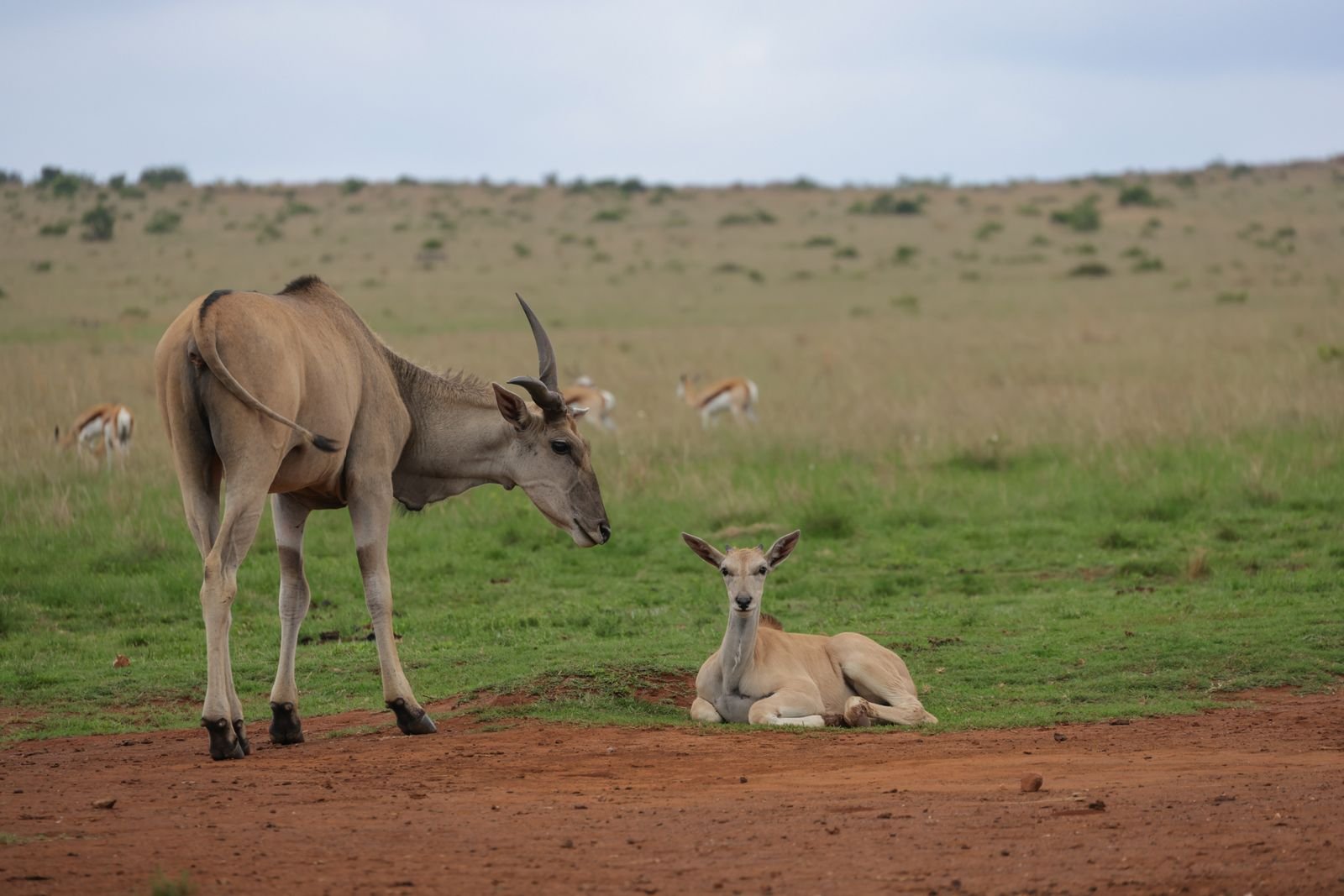
The eland of the Mkata Plains

The eland of the Mkata Plains

The eland is the largest antelope on earth, and the open floodplain here is considered the most reliable place in Tanzania to find one. Look for a heavy-shouldered, spiral-horned shape grazing apart from the smaller herds.

The Hippo Pools

The Hippo Pools

A pair of pools a few kilometres north of the main gate hold a resident pod of hippos year-round, alongside a shifting cast of waterbirds. It’s an easy, almost guaranteed add-on to any floodplain game drive.

Concentrated wildlife, easy to reach.

Mikumi’s open floodplain does the work a longer safari elsewhere needs more days to do.

Grazers of the floodplain

The open Mkata grassland supports large, easily seen herds — one reason Mikumi rewards visitors on a tight schedule.

  • Buffalo

    Often seen close to the roadside, sometimes in large herds.

  • Zebra and wildebeest

    Common across the open plains, especially near remaining water.

  • Impala

    Widespread on the grassland edges.

  • Eland

    The world’s largest antelope, most reliably found here of anywhere in Tanzania.

  • Giraffe

    Browsing the acacia and tamarind stands that fringe the Mkata River.

Predators of the plains

The floodplain’s open sightlines make Mikumi a good place to actually watch predators work, not just glimpse them.

  • Lion

    Prides often rest on flattened termite mounds, sometimes climbing trees during the rains.

  • Leopard

    Present but harder to find than the plains species.

  • Spotted hyena

    A regular scavenger and hunter across the grassland.

  • African wild dog

    An occasional visitor ranging in from the wider Selous–Nyerere ecosystem.

Woodland & hill specialists

Away from the floodplain, the miombo-covered foothills hold a different, quieter set of species.

  • Elephant

    Moves between floodplain and woodland, drawn to tamarind fruit.

  • Greater kudu

    A signature sighting of the miombo-covered hills.

  • Sable antelope

    Striking and uncommon, found in the same foothill woodland.

  • Birdlife

    More than 400 species recorded, including lilac-breasted rollers and bateleur eagles.

A single wet season, a single dry one.

Mikumi’s calendar is simpler than most Tanzanian parks — one long dry stretch, one long wet one, with a short lull in between.

The dry season

June to October

The floodplain dries out and wildlife concentrates around the Mkata River and the Hippo Pools.

Best for

Classic, concentrated game viewing on a short timeline.

Keep in mind

Dustier tracks and the busiest months, given how close Mikumi sits to Dar es Salaam.

The short rains

November to December

Rain freshens the grassland and the first European migrant birds begin arriving.

Best for

Birding and a greener, less dusty floodplain.

Keep in mind

Some afternoon showers can interrupt game drives.

The green season

January to February

A short dry spell within the rains brings good light and active birdlife.

Best for

Photography and birding between rain spells.

Keep in mind

Wildlife can be more spread out with water widely available.

The long rains

March to May

Mikumi is at its greenest and quietest, with the fewest other vehicles on the circuit.

Best for

A quiet, low-cost visit if you don’t mind muddier tracks.

Keep in mind

Some secondary roads close, keeping visits closer to the main circuit.

Late afternoon light over the Mkata Floodplain

Shaped by the mountains around it

Ringed by hills, lit like nowhere else.

Mikumi sits inside a ring of mountain ranges — the Uluguru, Rubeho and Udzungwa among them — and that shelter is credited with some of the most photographed light in southern Tanzania, especially in early morning and late afternoon.

Light

A favourite with photographers

Distance

Under 4 hours from Dar es Salaam

Floodplain

Open grassland likened to the Serengeti

Mikumi is a doorway, not a dead end.

Its position on the main southern route means Mikumi connects easily to mountains, forests and a much bigger wilderness beyond it.

  • Udzungwa Mountains

    A short drive away, Udzungwa trades open plains for rainforest trails, waterfalls and primate walks — a natural pairing with a Mikumi floodplain safari.

    Forest and waterfalls

  • Selous / Nyerere ecosystem

    Mikumi is directly contiguous with this much larger river wilderness to the south, part of the same protected landscape.

    The wilderness Mikumi borders

  • Uluguru Mountains

    Add mountain scenery and local culture on the way back toward Dar es Salaam or Morogoro town.

    Highland culture near Morogoro

  • Ruaha National Park

    The same highway that crosses Mikumi continues on toward Ruaha, for travellers who want to follow the floodplain into a bigger, wilder park.

    Continue west along the same road

Following the highway further west? Explore Ruaha National Park.

Three ways to fit Mikumi into a trip.

These are starting points. Every Dunia Moja safari can be tailored around your dates, pace, accommodation and budget.

The weekend safari

2 nights, best in Any month

  1. 1 Depart Dar es Salaam in the morning, arriving by early afternoon
  2. 2 Afternoon game drive across the Mkata Floodplain
  3. 3 Full day exploring the Kisingura Circuit, Vuma Hill and the Hippo Pools
  4. 4 Final morning drive, then return to Dar es Salaam

Mikumi & Udzungwa

4 to 5 days, best in June to February

  1. 1 Arrive and settle into the floodplain circuit
  2. 2 Full-day game drive covering the Hippo Pools and Vuma Hill
  3. 3 Transfer to Udzungwa Mountains National Park
  4. 4 Forest walk to a waterfall, with birding and primate viewing
  5. 5 Return to Dar es Salaam

The southern corridor

7 to 10 days, best in June to October

  1. 1 Break the journey south with a day or two in Mikumi
  2. 2 Continue west along the highway toward Ruaha
  3. 3 Several days of in-depth game drives in Ruaha
  4. 4 Optional extension south to the Selous–Nyerere wilderness
  5. 5 Return by road or scheduled flight

Good to know before you go.

The questions that matter when planning a Mikumi safari. If yours is not here, ask us.

What is Mikumi known for?

Mikumi is known for being Tanzania’s most accessible safari park — around 3 to 4 hours from Dar es Salaam — and for the Mkata Floodplain, an open grassland often compared to the Serengeti.

How far is Mikumi from Dar es Salaam?

About 283 km by road, usually 3 to 4 hours depending on traffic on the highway. Scheduled and charter flights are also possible.

Can Mikumi be visited on a weekend?

Yes. Its proximity to Dar es Salaam makes it Tanzania’s most practical short safari, and even two nights covers the main floodplain circuit.

What animals can we see in Mikumi?

Lion, elephant, buffalo, giraffe, zebra, wildebeest, impala, eland, greater kudu, sable antelope, hippo and crocodile are all regularly seen, with leopard and African wild dog as less predictable sightings.

Is Mikumi really like the Serengeti?

The open floodplain draws the comparison fairly, but Mikumi is far smaller and more compact. That makes it an easy stopover rather than a multi-day circuit on its own.

What is the highway doing inside the park?

The main Dar es Salaam–Zambia highway crosses Mikumi and effectively splits it in two. Almost all game drives stay on the floodplain side; the hillier side beyond it makes up most of the park’s area but is largely closed to general tourism.

Can Mikumi be combined with other parks?

Yes. It sits naturally between Dar es Salaam, the Udzungwa Mountains, and the road corridor toward Ruaha and the Selous–Nyerere ecosystem.

The quickest way into wild Tanzania.

Tell us how much time you have, and whether Mikumi is the whole trip or the first stop on a longer one. We will build the drive, the days and the circuit around it.

Start planning